

Wimbush Consulting is a strategy, people, and operations consulting firm that champions Good Work.
We partner with leaders and organizations to align strategy, people, and operations so that doing Good Work becomes the norm, not the exception.
Good Work is a Different Way to Run Your Organization
A disciplined, humane approach to aligning strategy, people, and operations so your team can do its best work without burning out.
Most organizations today are trying to do more with less. Budgets are tight, expectations are rising, and the work itself is complex and high stakes. Whether you’re running a nonprofit, a law firm, or a consulting practice, the pattern is the same:
Delivery depends on a handful of overstretched people
Internal systems are held together by goodwill and late nights
Turnover, burnout, and operational fragility sit just below the surface
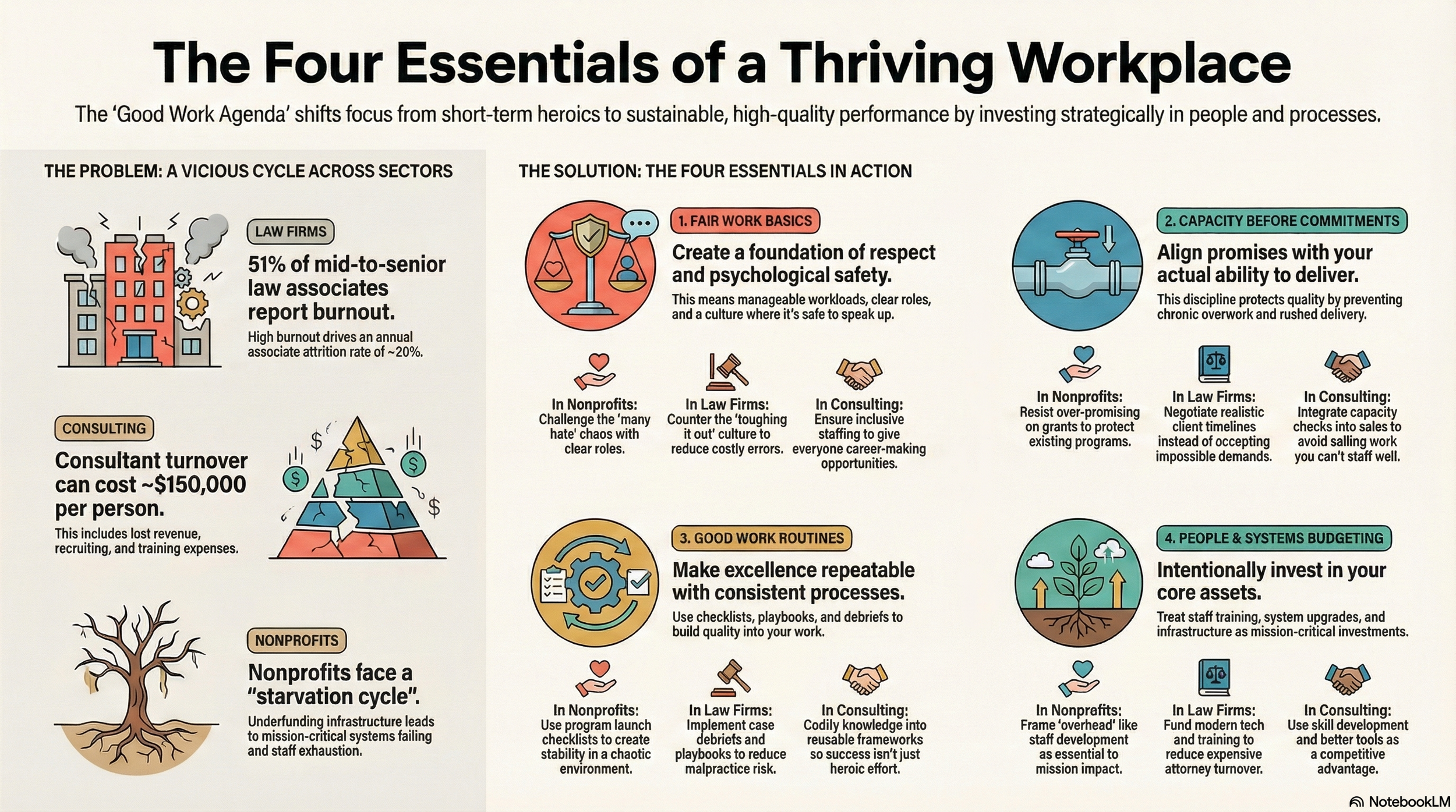
The Good Work Agenda is my answer to that problem. It’s a management philosophy for leaders who want to deliver reliably without grinding their teams down.
How I Developed the Good Work Agenda
I’m Chris Wimbush. Over the last decade, I’ve led and advised organizations from the inside: as a DOJ trial lawyer, as a COO and Interim President of a national nonprofit, and as a people-and-operations consultant to firms and social sector organizations.
A few things became painfully clear:
Talent and mission weren’t the issue — operating systems were
Most teams were succeeding despite their internal practices, not because of them
Leaders were hungry for structure that felt humane, not bureaucratic or trendy
The Good Work Agenda grew out of that lived experience.
I didn’t design it in a vacuum or as a one-size-fits-all framework. It’s the distillation of:
Stabilizing a multi-million-dollar nonprofit through leadership transition while keeping programs, fundraising, and culture moving
Helping professional services firms clarify their offers, protect margins, and retain their best people
Working shoulder-to-shoulder with leaders who were trying to be both ambitious and fair to their teams
Along the way, I stress-tested the ideas against established research in organizational behavior, operations, and finance, and then translated them back into plain language and practical routines.
See How Good Work Fits Your Organization
For Nonprofit Leaders
See how the Good Work Agenda can make your mission sustainable for your people, not just your programs.
For Law Firm Partners
Learn how to protect your people, your cases, and your margins with a healthier way of running the firm.
Consulting Firm Leaders
Discover how to scale your firm without burning out the consultants your clients rely on.
Services at a Glance
Strategic Planning Facilitation
Concise, structured planning that turns strategy into a realistic, week-to-week operating plan instead of a document that gathers dust.
Fractional Chief People Officer
Part-time senior people and culture leadership to design fair, clear, and sustainable systems for managing, developing, and compensating your team.
Fractional Chief Operating Officer
Part-time operational leadership to align strategy, tools, and processes—improving efficiency, data use, and change adoption across the organization.
Culture-Operations Transformation Projects
Deep-dive projects that connect your values to daily work, fixing meeting patterns, handoffs, and tools so teams can move faster with less burnout.
AI Operations Pathfinder
A focused path to practical AI adoption that streamlines everyday workflows, builds staff confidence, and delivers measurable efficiency gains.
Good Work Culture Alignment Assessment
A structured look at how well your current culture supports the Good Work Agenda—revealing where default norms help or hinder Fair Work, capacity, and sustainable routines.
Team Effectiveness Assessment
An analysis of how your team communicates, collaborates, and executes, highlighting specific shifts that will improve performance and cohesion.
Team Psychological Safety Assessment
A targeted assessment of how safe it feels to speak up, raise concerns, and take risks together—plus concrete steps to strengthen that foundation.
Good Work Cultural Commitments™ Workshop
A facilitated reset that helps teams define shared Cultural Commitments™ aligned with Good Work principles, so everyday behavior matches the way they say they want to work.
Individual People Manager 1:1 Coaching
Confidential coaching for managers to improve how they lead, give feedback, and run their teams, using practical frameworks and real-world scenarios.
Design Your Career Pivot™ 1:1 Workshops
A structured, human-centered process to explore new directions, clarify values, and test career pivots through low-risk experiments.
Evidence-Based Executive Coaching
Research-backed coaching for senior leaders focused on behaviors that directly shape strategy, culture, and how work actually gets done.
Behind the Good Work Agenda: FAQ
Where this framework comes from and why you can trust it
-
The Good Work Agenda is a management philosophy for organizations that depend on people to do complex, high-stakes work—nonprofits, law firms, consulting firms, and other mission-driven teams.
-
It rests on two pillars: lived experience and serious research.
Lived experience.
I’ve led annual planning, stabilized leadership transitions, built operating rhythms from scratch, and sat with teams on the edge of burnout. The four essentials are drawn from what actually helped in those roles and what clearly did not.
Serious research.
I’ve then stress-tested those patterns against a cross-disciplinary evidence base in organizational behavior, operations/reliability, finance, and professional services, including:
Amy Edmondson on psychological safety and team learning (The Fearless Organization)
Kegan & Lahey on deliberately developmental organizations (An Everyone Culture)
Daniel Coyle’s The Culture Code and Erin Meyer’s The Culture Map on culture and collaboration
John Doerr’s Measure What Matterson focus and OKRs
Forsgren, Humble & Kim’s Accelerateon delivery practices and performance
Weick & Sutcliffe’s Managing the Unexpected on high-reliability organizations
Atul Gawande’s The Checklist Manifesto on checklists and reducing error
“The Nonprofit Starvation Cycle” (SSIR) and “Pay-What-It-Takes Philanthropy” (Bridgespan) on full-cost funding
Zeynep Ton’s “Good Jobs” work on slack capacity and people investment
The Good Work Agenda is essentially a translation layer between this research and the messy reality of your organization.
-
The research isn’t something I wave around in meetings; it’s the guardrail behind the work. In practice, it helps us:
Sharpen the diagnosis. We get clearer on whether a problem is really about strategy, or actually about capacity, culture, or routines.
Choose fewer, better interventions. Instead of a long wish list, we focus on a small number of changes that evidence and experience suggest will move the needle.
Translate into plain language. We talk about “how we run the week,” “how we set expectations,” and “how we decide what not to do,” not about HROs and psychological safety frameworks—unless your team wants that vocabulary.
Measure what matters. Where possible, we track retention, rework, error rates, cadence adherence, margin predictability, and staff perceptions of safety and clarity—indicators research suggests are meaningful.
My role is to stand at the intersection of research and reality: bringing the best of what we know about organizations into your context, in ways your people can actually live with.
-
The principles of the Good Work Agenda are stable; the practice is intentionally evolving. I’m continually:
Reading and synthesizing new work in organizational behavior, operations, finance, and professional services
Learning from what works (and what doesn’t) in client engagements
Refining tools based on real feedback
Adjusting sector-specific versions (nonprofit, law firm, consulting) as laws, norms, and market dynamics shift
When you work with me, you’re not getting a frozen framework from years ago. You’re getting a philosophy that’s grounded in research, tested in the field, and updated as the world changes.